Money Time is Pragmatic Play’s live game show, launched in September 2025. The action centres on a 54-segment wheel with two bet families:
- Number bets: 1, 2, 5, and 10
- Bonus games: four different bonus rounds
The quoted theoretical RTP is 96.56%. That headline figure matters, but not for the reason most trackers think.

The One Feature That Changes Everything
The defining mechanic is the Bet Spot Booster.
Before every single spin, one betting spot is randomly selected (a number or a bonus) and receives a multiplier from 2x up to 50x. If the wheel lands on that exact boosted spot and the player has money on it, the payout is multiplied by the booster.
This means the game’s risk profile is not “steady RTP over time”. It is high variance by design, injected into every round.
Why The RTP Feels “High” but Results Still Swing Hard
Without the booster, outcomes would look more like a classic wheel game: small wins, occasional bonuses, and predictable-looking streaks.

With the booster, even common outcomes can become big:
- A normal 10x can become 500x if it is boosted by 50x.
- Even the frequent 1x segment can jump to 50x on the right round.
For bonus games, the booster applies to the final bonus payout, which is how the game reaches its theoretical maximum headline numbers (including a quoted 40,000x ceiling).
Can Tracking Hourly Results Create an Edge
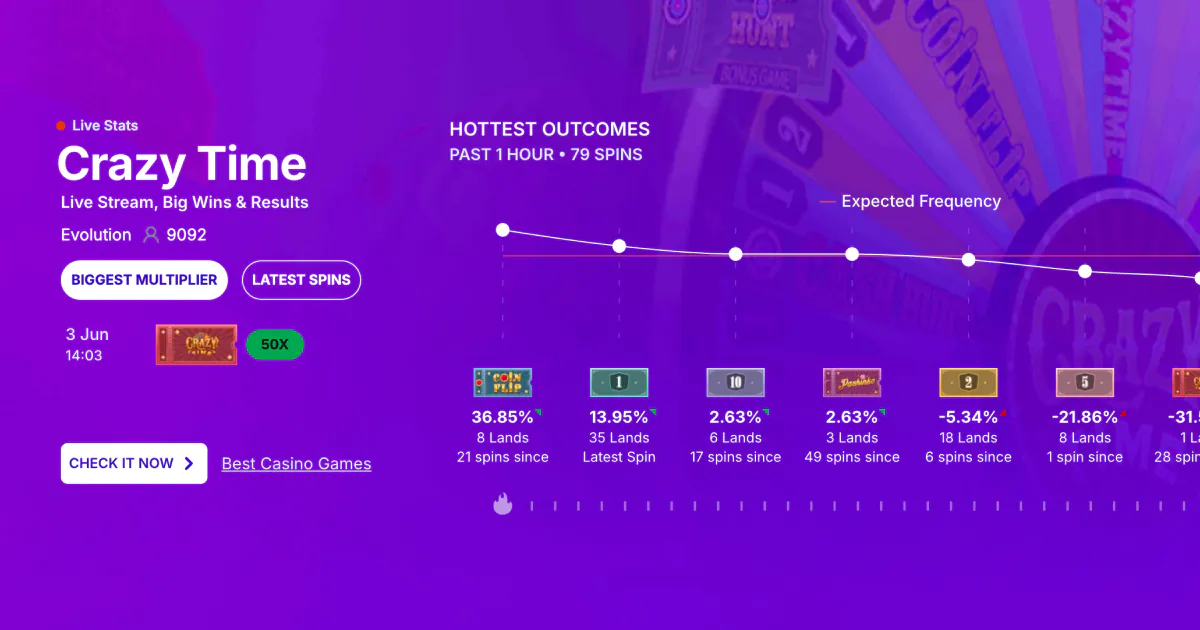
Many players track results hour-by-hour, daily, and weekly to hunt for patterns. Short windows sometimes show spikes that feel meaningful. For example, a rare bonus may appear more often than its stated probability during a single hour.
That does not create reliable predictive power.
What The Data Suggests About “Hot” and “Cold” Streaks
The key issue is regression to the mean.
Over very short samples (like an hour), results can deviate noticeably from the theoretical distribution. But when you zoom out to 24 hours, outcomes tend to snap back close to expectation. Over a week or a month, the distribution becomes very smooth and close to the theoretical model.
Each spin is treated as independent. So chasing an “hourly anomaly” is essentially chasing noise, not a repeatable signal.
The Four Bonus Games and Their Real Profiles
Bonuses are where the “life-changing” payouts can happen, but they are not equal. They differ in both hit rate and average base payout (before any booster).
- Cash Roll: 4 segments → 7.41% hit rate. Average base payout around 13.1x. Most frequent, lowest average.
- Bank Heist: 2 segments → 3.70% hit rate. Average base payout around 28x. Tied to the biggest theoretical ceiling.
- Coin Rush: 2 segments → 3.70% hit rate. Average base payout around 45x. Same rarity as Bank Heist, but higher average.
- Money Time: 1 segment → 1.85% hit rate. Average base payout around 77x. Rarest, highest average.
One structural takeaway stands out: Coin Rush and Bank Heist have identical rarity, yet Coin Rush has a much higher average (45x vs 28x). That suggests Coin Rush’s internal mechanics produce stronger typical outcomes, even if Bank Heist owns the extreme top-end ceiling.
What “Big Wins” Look Like In Practice

Because the game is new, the recorded history is limited. Still, early large wins fit the same pattern: feature stacking.
The biggest payouts come from combining:
- a high-potential outcome (often a bonus), and
- a strong booster landing on that same bet spot.
Examples from recorded results include:
- 2,850x from Bank Heist when it also carried the 50x booster.
- 1,650x from the rare Money Time bonus with a 25x booster.
Those results help separate the theoretical ceiling from what players are more likely to see. Meaningful hits often appear more realistically in the 100x to 3,000x band, while the absolute maximum requires multiple extreme conditions at once.
A Strategy That Matches How Money Time Is Built

Money Time rewards structure-based thinking, not timing-based thinking.
- If the goal is more frequent hits, number bets—especially 1 (often cited around 46.3% hit frequency)—offer many chances to “catch” a boosted payout.
- If the goal is bigger base potential, bonus bets are the route, with Money Time (77x average) at the top end and Coin Rush notable for its strong average at the same rarity as Bank Heist.
The practical decision is a volatility choice: more frequent smaller outcomes versus rarer higher-potential outcomes, with the booster adding extra variance on top of both.
The Question Players Should Ask Themselves
Older wheel games often had a “safe” low bet that stayed low. Money Time removes that comfort, because the booster can turn even the smallest segment into a high-variance event.
If any segment can suddenly become 50x, the “safe bet” is no longer truly safe—it just has a different kind of volatility.
That is the real shift Money Time introduces: dynamic volatility, guaranteed every spin.